UNESCO sites in Sicily
Sicily is home to some of the most remarkable **UNESCO World Heritage Sites** in the Mediterranean, each representing a chapter of the island’s complex history — from ancient Greek temples and Baroque towns to volcanoes and island archipelagos. Together, they tell the story of Sicily’s role as a crossroads of civilizations, cultures, and nature.
- Visit Sicily
- 3 min read
UNESCO World Heritage Sites in Sicily — A Journey Through Millennia
🌍 Overview
Sicily’s UNESCO-listed sites highlight its unique blend of nature, architecture, and human history. The island’s strategic position in the Mediterranean attracted Greeks, Romans, Arabs, Normans, and Spaniards — all leaving their mark. Today, these sites stand as living museums, showcasing over 2,500 years of cultural evolution.
🏛️ 1. Valley of the Temples (Agrigento)
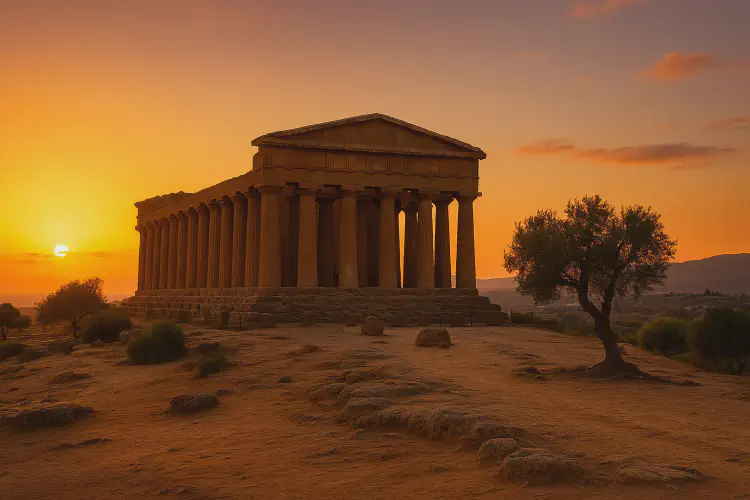
One of the most famous archaeological sites in the world, the Valley of the Temples preserves the grandeur of ancient Akragas, a major Greek colony. Its perfectly aligned Doric temples — including the Temple of Concordia and Temple of Juno — glow gold at sunset, symbolizing Sicily’s ancient power and beauty.
Inscribed: 1997
Criteria: Cultural — masterpiece of Greek art and urban planning.
🏺 2. Villa Romana del Casale (Piazza Armerina)
A stunning Roman villa from the 4th century CE, famous for its 3,500 m² of mosaics, considered the finest in the Roman world. The mosaics depict mythological scenes, hunting expeditions, and daily life — offering a glimpse into the opulence of ancient Sicily.
Inscribed: 1997
Criteria: Cultural — outstanding preservation of Roman domestic art.
🏰 3. Arab-Norman Palermo and the Cathedrals of Cefalù and Monreale
This group of monuments reflects the multicultural harmony of 12th-century Sicily, where Arab, Norman, and Byzantine traditions merged. Highlights include the Palatine Chapel, Cefalù Cathedral, and Monreale Cathedral, adorned with golden mosaics and intricate geometric designs.
Inscribed: 2015
Criteria: Cultural — example of medieval coexistence and artistic synthesis.
🏛️ 4. Late Baroque Towns of the Val di Noto
Rebuilt after the devastating 1693 earthquake, these eight towns — Noto, Ragusa, Modica, Scicli, Caltagirone, Palazzolo Acreide, Militello in Val di Catania, and Catania — showcase the height of Sicilian Baroque architecture. Their symmetrical plans, luminous façades, and theatrical staircases represent a collective rebirth through art.
Inscribed: 2002
Criteria: Cultural — unified artistic response to disaster.
🌋 5. Mount Etna
Europe’s highest and most active volcano, Mount Etna is both a geological wonder and a sacred landscape. Its eruptions have shaped the island’s ecology, soil, and mythology for millennia. Visitors can hike its lava fields and craters for a firsthand experience of nature’s raw power.
Inscribed: 2013
Criteria: Natural — ongoing geological processes and biodiversity.
🏝️ 6. Aeolian Islands
A volcanic archipelago north of Sicily, including Lipari, Vulcano, Stromboli, Panarea, Salina, Filicudi, and Alicudi. The islands illustrate volcanic activity and island evolution, with Stromboli’s frequent eruptions offering a live display of natural forces.
Inscribed: 2000
Criteria: Natural — outstanding volcanic phenomena and landscape.
🏞️ 7. Syracuse and the Rocky Necropolis of Pantalica
This UNESCO site combines the ancient Greek city of Syracuse, a former rival of Athens, with the prehistoric necropolis of Pantalica, containing over 5,000 rock-cut tombs. It encapsulates the island’s transition from prehistoric to classical civilizations.
Inscribed: 2005
Criteria: Cultural — continuity of human settlement from Bronze Age to classical era.
🧭 Summary
Sicily’s UNESCO World Heritage Sites capture the essence of the island — where nature, art, and history converge. From the glowing temples of Agrigento to the mosaics of Piazza Armerina, from Mount Etna’s fiery slopes to the serene Aeolian Islands, each site offers a window into Sicily’s enduring legacy as a bridge between East and West, past and present.